
How to Change Your USDA Organic Certifier Without a Gap

Is Your Organic Certifier Still the Right Fit? How to Change Organic Certifiers Without a Gap
Short answer: Yes, you can change your organic certifier. Every USDA-accredited certifier applies the same USDA organic regulations, but coverage, inspection availability, scopes and fees differ. Under USDA NOP Instruction 2604, you apply to the new certifier with a complete Organic System Plan and keep your current certificate active until the new one is issued.
The certifier you chose when your organic operation was smaller may not fit your business today. Many operations now export to new markets, run a U.S. importing entity, operate several facilities or receive buyer requests for PrimusGFS alongside USDA Organic.
Many certified operations overlook one point: changing certifiers is permitted, and renewal season is the right moment to evaluate it.
Can you change your USDA Organic certifier?
Yes. Any certified organic operation can move to another USDA-accredited certifying agent. The change is not a certificate transfer: the operation applies to the new certifier as a new applicant, submits a complete Organic System Plan (OSP) and passes a full on-site inspection before the new certificate is issued.
These requirements apply whether the change is a business decision or the result of the current certifier losing or surrendering its accreditation.
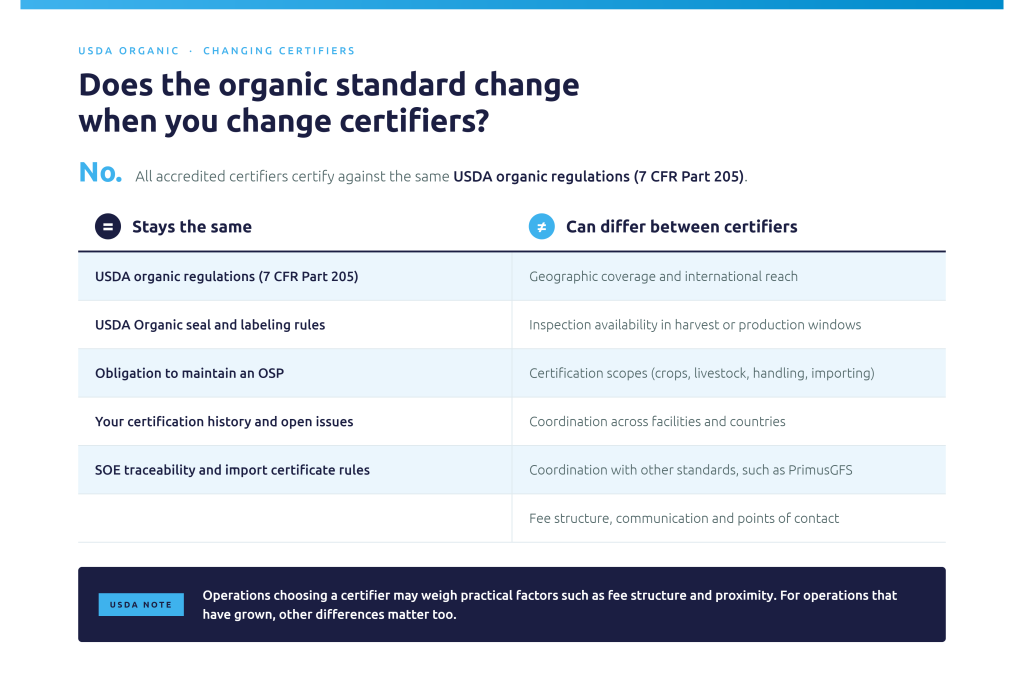
How do you know your operation has outgrown its certifier?
A few years ago, your operation may have had one facility, one market and one certification. Today it may look different:
- Organic suppliers in several countries
- A U.S. entity acting as importer
- Buyers requiring PrimusGFS or another food safety program alongside USDA Organic
- Harvest windows that make inspector availability critical
Since the Strengthening Organic Enforcement (SOE) rule became fully effective on March 19, 2024, organic supply chains operate under stronger requirements for traceability, import certificates, records and oversight. The renewal question is therefore not only “How much does renewal cost?” but “Does our certifier still fit the operation we have today?”
What should you ask before your next organic renewal?
- Can one certification body cover the markets where we operate? Coordinating countries, suppliers and facilities through several organizations creates unnecessary complexity.
- Can our certifications be better coordinated? Count the inspections, calendars and certification contacts your team manages each year. Where scopes and schedules allow, combined inspections reduce disruption, while each certification keeps its own requirements and certification decision.
- Is our certifier available when our operation is running? For farms, packinghouses and seasonal operations, inspection capacity must align with harvest and production windows.
- Does our certification structure support our international trade? Under SOE, every certified organic shipment imported into the United States must be associated with an electronic NOP Import Certificate issued through USDA’s Organic INTEGRITY Database.
- Do we clearly understand what we are paying for? Scope, inspections, travel, additional sites and other certification activities all affect the final cost. Compare beyond the headline fee.
How do you change organic certifiers without losing certification?
Planned correctly, a change of certifier creates no certification gap. NOP 2604 sets the sequence:
- Review your operation before the renewal date: markets, facilities, import activities and additional standards.
- Apply to the new certifier as a new applicant with a complete Organic System Plan.
- Keep your current certification active so you can keep selling and representing products as organic.
- Complete the OSP review and a full on-site inspection by the incoming certifier.
- Receive the new certificate, then surrender the old one. Never in the reverse order.
- Update labels and records, including documents tied to NOP Import Certificates.
Comparing certifiers before your renewal? Contact usacertifications@controlunion.com to review your certification scope.
What happens to your certification history and labels?
Your certification history stays with the operation. Unresolved noncompliances remain relevant, and the incoming certifier must evaluate the operation before issuing a new certificate.
Labels must change. After a voluntary change, operations may not use up labels that identify the previous certifier; new labels naming the new certifier apply once the change takes effect. A use-up period is possible only when the previous certifier lost or surrendered its accreditation.
If your certifier loses its accreditation, you must apply to a new certifier within 60 days of the surrender, suspension or revocation.
Why certify with Control Union?
Control Union is an independent, USDA-accredited certification body with more than 100 years of experience, operations in more than 80 countries and more than 200 certification programs. It certifies USDA Organic and PrimusGFS, among other agriculture, food safety and supply-chain standards.
For operations that hold both, Control Union can combine organic and PrimusGFS inspections where scopes and schedules allow. The standard does not change; the certification fits the way your business operates.