
How to Choose an Organic Certifier: 8 Criteria

How to Choose an Organic Certifier, and How to Switch Without a Lapse
Short answer: Choose a certifier that is USDA-accredited for every scope you need, has auditors near your sites, can cover the other standards your buyers require (such as PrimusGFS), and can support your import and export trade lanes. To switch, apply to the new certifier before your renewal date, disclose your certification history and noncompliances, and keep your current certificate active until the new one is issued.
Every USDA-accredited certifier applies the same regulation. The differences are in coverage, capacity, communication and how well the certifier fits the structure of your operation. Those differences affect timelines, costs and the number of audits you host each year.
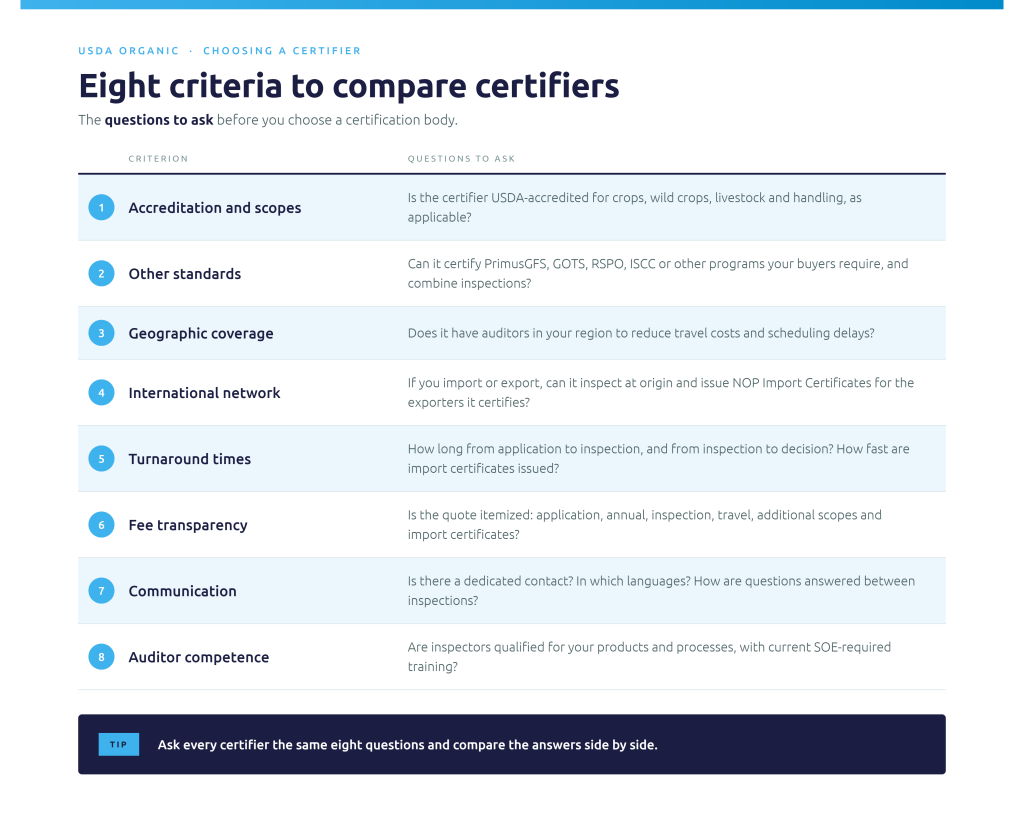
Why the right fit matters more after SOE
The Strengthening Organic Enforcement rule increased what certifiers must verify: fraud prevention plans, mass-balance and trace-back audits, import certificates and unannounced inspections. Operations with complex supply chains, multiple sites or international suppliers benefit from a certifier with the capacity and reach to handle that scope efficiently.
For fresh produce suppliers, the ability to combine organic and food safety inspections also reduces days of interruption during the season.
How to transfer your certification
- Start 3–4 months before your renewal date. Under USDA instruction NOP 2604, you keep your current certification until the new certifier grants certification, so there is no lapse.
- Request an itemized quote from the new certifier and confirm it covers all your scopes, sites and other programs.
- Submit a complete new application and Organic System Plan. A change of certifier is not a transfer of files: the new certifier reviews the operation as a new applicant. Your current OSP is the starting point.
- Disclose your certification history, including previous certifiers and any noncompliances, with evidence of corrective actions.
- Expect a status check. The new certifier requests information on your current certification status, including any open noncompliances or adverse actions. These must be resolved before certification can proceed.
- Surrender the previous certificate only after the new certification is granted.
- Update your customers and confirm that your new certificate is visible in the Organic Integrity Database.
Red flags when comparing
- Quotes that omit inspection travel or import certificate fees
- No auditors in your region during your harvest season
- No clear process for issuing import certificates
- Separate certification bodies needed for organic and food safety, with no coordination
Control Union as your certification body
Control Union Certifications is accredited by the USDA under the National Organic Program and certifies fresh produce operations under PrimusGFS. With more than 100 years of experience, operations in more than 80 countries and more than 200 certification programs, we certify operations from origin to the U.S. market and combine inspections to reduce disruption.