
NOP Import Certificates: How They Work Under SOE

Short answer: An NOP Import Certificate is an electronic document, generated in the USDA Organic Integrity Database (OID) by the exporter’s certifying agent, that confirms a specific organic shipment meets USDA organic standards. Since March 19, 2024, every organic product imported into the United States must be declared to U.S. Customs and Border Protection (CBP) with data from a valid NOP Import Certificate.
Imports are where long and complex supply chains meet the U.S. organic market. Before the Strengthening Organic Enforcement (SOE) rule, a shipment could arrive with paper documents that were difficult to verify. Import certificates connect each shipment to a certified exporter, a certified importer and a traceable record.
Who issues an NOP Import Certificate?
The certifying agent of the exporter issues the certificate in OID. The exporter requests it, and the certifier reviews the shipment information before issuing it. The certificate can cover a single shipment, or multiple shipments within a defined timeframe and volume.
The importer of record must be certified (unless exempt) and must use the certificate data when filing the entry in CBP’s Automated Commercial Environment (ACE).
How the process works, step by step
- The exporter prepares the shipment and requests an import certificate from its certifying agent through OID.
- The certifier verifies that the exporter is certified for the product, that quantities are consistent with production or purchase records, and that shipment data are complete.
- The certifier issues the NOP Import Certificate in OID, with a unique certificate number.
- The importer files the entry in ACE, including the import certificate number and organic data elements.
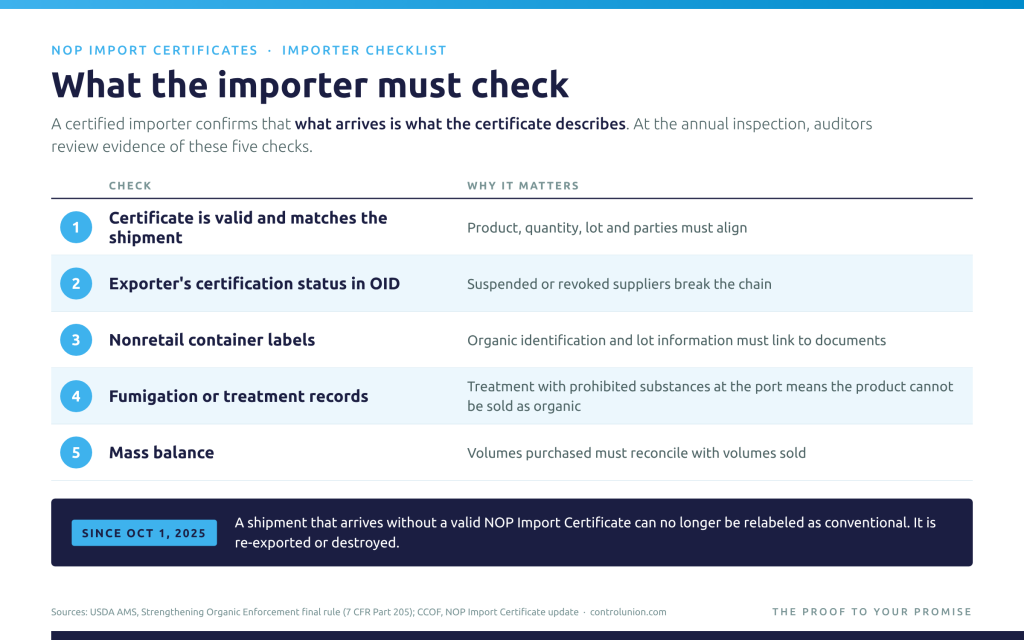
- The importer verifies on arrival that the product, quantities, lot numbers and documentation match the certificate.
- Records are kept so the shipment can be traced in both directions during audits.
Two points are often missed. First, the certificate must be issued before the shipment leaves origin. Second, it is required for every organic import, including products from countries with an organic equivalency arrangement with the United States, such as Canada and the European Union.
How import certificates connect to fraud prevention plans
Under SOE, every certified operation must include a fraud prevention plan in its Organic System Plan. For importers, the import certificate is one control within that plan, not the whole plan. A robust fraud prevention plan typically describes:
- Vulnerability assessment: which products, origins and suppliers carry the highest risk
- Supplier verification: how the operation confirms certification and monitors status changes in OID
- Monitoring practices: document checks, testing where risk justifies it, and reconciliation of volumes
- Response procedures: what happens when a discrepancy is found, including reporting to the certifier
Auditors verify the plan against practice. A plan that exists only on paper is a common finding.
What happens when a shipment arrives without a valid certificate?
The product loses its organic status at the border. Since October 1, 2025, it can no longer be reconditioned, meaning relabeled and invoiced as conventional. Certified importers may re-export, donate (with documentation to their certifier) or destroy it, with a CBP Certificate of Destruction. Uncertified importers may only re-export or destroy it.
USDA is also acting on import certificate data. In its May 2026 Organic Insider enforcement update, the National Organic Program reported two 2025 investigations into importers of China-origin products, one bringing in plant extracts and fruit and vegetable juices, the other frozen vegetables. Both had imported organic products without the required import certificates and sold them as organic. In the first case, the importer’s certifier reached a settlement, and cooperation between the two certifiers led to the supplier’s suspension. In the second, the products were re-exported before reaching U.S. buyers.
Common mistakes that delay shipments
- Requesting the certificate too late in the export process
- Mismatches between commercial invoices, bills of lading and the certificate
- Importer not certified, or certified without the correct handling scope
- Product treated at the port without documentation of the substance used
- No reconciliation between import certificates and inventory records
How Control Union certifies importers and exporters
Control Union Certifications is accredited by the USDA to certify operations under the National Organic Program and operates in more than 80 countries.
With offices in origin countries, including across Latin America, we inspect and certify operations on both sides of the trade lane under one set of documentation standards, and we issue NOP Import Certificates for the exporters we certify. The same relationship can cover other programs your buyers require, such as GOTS, RSPO, ISCC or PrimusGFS.