
Organic Certification Cost Share 2025–2026: How to Apply
Organic Certification Cost Share 2025–2026: Who Qualifies and How to Apply Before December 31
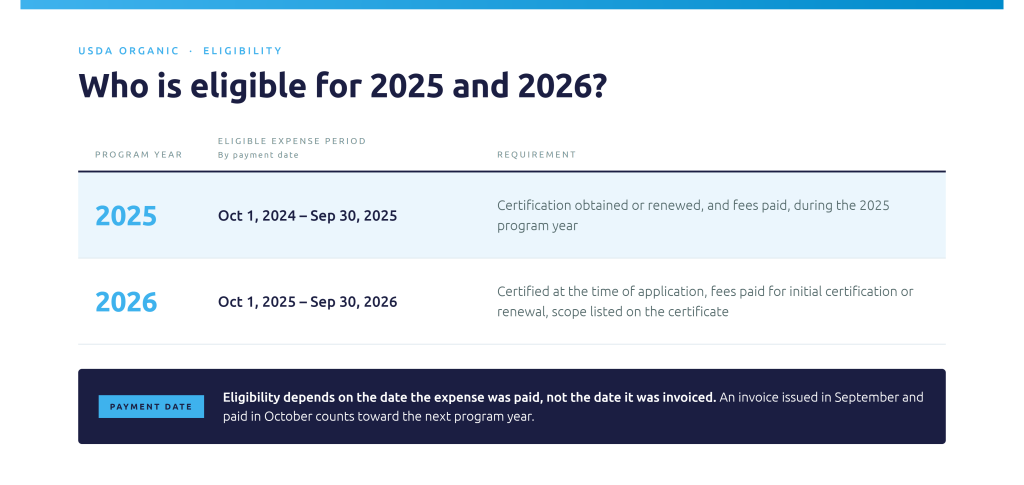
Short answer: The USDA Organic Certification Cost Share Program (OCCSP) reimburses certified organic operations for 75% of eligible certification costs, up to $750 per scope, for program years 2025 and 2026. Applications go to the local Farm Service Agency (FSA) office, one per program year, and close on December 31, 2026. Funds are paid first-come, first-served.
The program returned in July 2026 after a one-year pause. USDA reopened both program years at once, which means many certified operations can file two applications before the end of the year.
What does the cost share program reimburse?
The OCCSP covers part of the cost of obtaining or maintaining USDA organic certification:
- Reimbursement rate: 75% of eligible certification costs.
- Maximum payment: $750 per certification scope, per program year.
- Eligible scopes: crops, wild crops, livestock and processing/handling.
An operation certified for more than one scope can claim each scope listed on its certificate. A crop and handling operation, for example, can receive up to $1,500 per program year.
Eligible costs include application, inspection and certification fees paid to a USDA-accredited certifying agent. Costs not tied to organic certification are not eligible.
What changed in this round?
Two program years, one deadline. Each program year needs its own application. Operations can submit both together or file 2025 now and 2026 later, provided both reach FSA by December 31, 2026.
FSA is the only channel for now. State departments of agriculture are not processing applications. USDA has said participating state agencies can administer the program later, once its state application process is complete.
New FSA customers register first. An operation that has never worked with FSA must establish a customer record at its county office before the application is processed. This usually requires an in-person appointment.
Limited funds. Payments are made in order of receipt until each year’s funds are exhausted. Applications received after that point are not paid.
What documents does FSA require?
A complete application includes:
- Form CCC-884, both pages.
- A copy of the USDA organic certificate showing each scope claimed.
- Itemized invoices or receipts for eligible costs paid within the eligible period.
- Form AD-2047 (Customer Data Worksheet) and Form SF-3881 (ACH Vendor/Miscellaneous Payment Enrollment), if not already on file with FSA.
If an invoice combines eligible and non-eligible charges, submit the full invoice and report only the eligible amount on Form CCC-884. This applies to operations that combine their organic inspection with another program, such as PrimusGFS, in a single visit: only the organic certification costs are eligible.
Certified with Control Union? Request copies of your USDA organic certificate and itemized certification invoices for 2025 and 2026 at organicUSA@controlunion.com. Include your operation name, client number and the program years you are applying for.
Common mistakes that delay payment
- Claiming expenses paid outside the October 1 – September 30 window of the program year.
- Claiming a scope that does not appear on the organic certificate.
- Submitting one combined application for 2025 and 2026 instead of two.
- Reporting the full amount of an invoice that includes non-eligible charges.
- Waiting for the FSA customer registration until December, when county office appointments are limited.
Where to get help with the application
The local FSA county office answers questions on eligibility and forms and confirms where the application must be sent. Office details are available through the USDA Service Center Locator on farmers.gov. Form CCC-884 and its instructions are published on the FSA program page.
The OCCSP is administered by the U.S. Department of Agriculture. Control Union does not prepare, process or approve cost share applications. Our role is limited to providing certified clients with copies of their certification records.
Certification with Control Union
Control Union Certifications is accredited by the USDA to certify operations under the National Organic Program. We certify crop, wild crop, livestock and handling operations, and we can combine your organic inspection with PrimusGFS and other programs in a single visit. Funding for the cost share program is authorized through fiscal year 2031, so operations that certify now can apply in future program years.