
Organic Fraud Prevention Plan: What Certifiers Verify

What Is an Organic Fraud Prevention Plan, and What Do Certifiers Verify?
An organic fraud prevention plan is the part of an operation’s Organic System Plan that describes how it verifies its suppliers and the organic status of the products it receives, and how it prevents organic fraud. Under the Strengthening Organic Enforcement rule, every certified organic operation must have one, scaled to its activities, scope and complexity.
The requirement has applied since March 19, 2024, when the Strengthening Organic Enforcement (SOE) rule took effect. Its commercial weight is clear in the Organic Trade Association’s 2026 consumer perception study: 43% of Gen Z and Millennial organic shoppers say they are willing to pay up to 20% more for organic products. That premium depends on buyers trusting that the product is what the label says.
Why does organic integrity carry commercial value?
Organic integrity carries commercial value because shoppers pay more for organic only when they trust that the product is genuinely organic. The organic fraud prevention plan is one of the controls that protects that trust across the supply chain.
The figures show what is at stake. According to the Organic Trade Association’s 2026 Organic Market Report, U.S. sales of certified organic products reached $76.6 billion in 2025. The association’s 2026 consumer study, conducted with Mercury Analytics in August 2026 among more than 1,000 Gen Z and Millennial shoppers, found that:
- 91% would pay at least some premium for an organic product over a non-organic version.
- 43% would pay up to 20% more, and 14% up to 30% more.
- 90% are familiar with the USDA organic seal.
The USDA organic regulations define organic fraud as the deceptive representation, sale or labeling of nonorganic agricultural products or ingredients as “100 percent organic,” “organic” or “made with organic” (7 CFR 205.2). A single fraudulent shipment affects every buyer downstream that relabels, processes or resells it.
What does the Strengthening Organic Enforcement rule require?
The Strengthening Organic Enforcement rule requires certified operations to develop and implement improved recordkeeping and organic fraud prevention procedures, and requires certifiers to conduct supply chain traceability audits. USDA published the final rule on January 19, 2023, and operations had to comply by March 19, 2024.
Among its main changes, SOE:
- Expanded who must be certified. More operations in the supply chain, including importers, certain brokers and traders, now need organic certification.
- Made fraud prevention part of the Organic System Plan. Monitoring practices must include verification of suppliers and of the organic status of products received (7 CFR 205.201(a)(3)).
- Required electronic NOP Import Certificates for every certified organic shipment entering the United States, explained in [Insertar link: artículo “NOP Import Certificates: How They Work Under SOE” (/insight/nop-import-certificate-guide/)].
- Strengthened on-site inspections. Certifiers must conduct unannounced inspections of at least 5% of the operations they certify each year, and verify traceability back to the last certified operation (7 CFR 205.403).
Who needs an organic fraud prevention plan?
Every certified organic operation needs an organic fraud prevention plan, from a single-crop farm to a multinational importer. The requirement applies “as appropriate to the certified operation’s activities, scope, and complexity” (7 CFR 205.201(a)(3)), so the depth of the plan follows the risk profile of the operation.
In practice, the plan for a farm that sells its own harvest to one handler is shorter than the plan for a trader that sources the same commodity from several countries. Both, however, must show how the operation confirms that what it receives and sells is organic. Operations that are exempt from certification under 7 CFR 205.101 do not submit an Organic System Plan, but they must still comply with the applicable production, handling and labeling requirements.
What should an organic fraud prevention plan include?
An organic fraud prevention plan should describe the operation’s vulnerabilities to organic fraud, the measures that address them, and how the operation monitors that those measures work. The USDA organic regulations set the requirement but not a template; the Organic Trade Association’s best-practice guidance structures the plan around a vulnerability assessment, mitigation measures and ongoing monitoring.
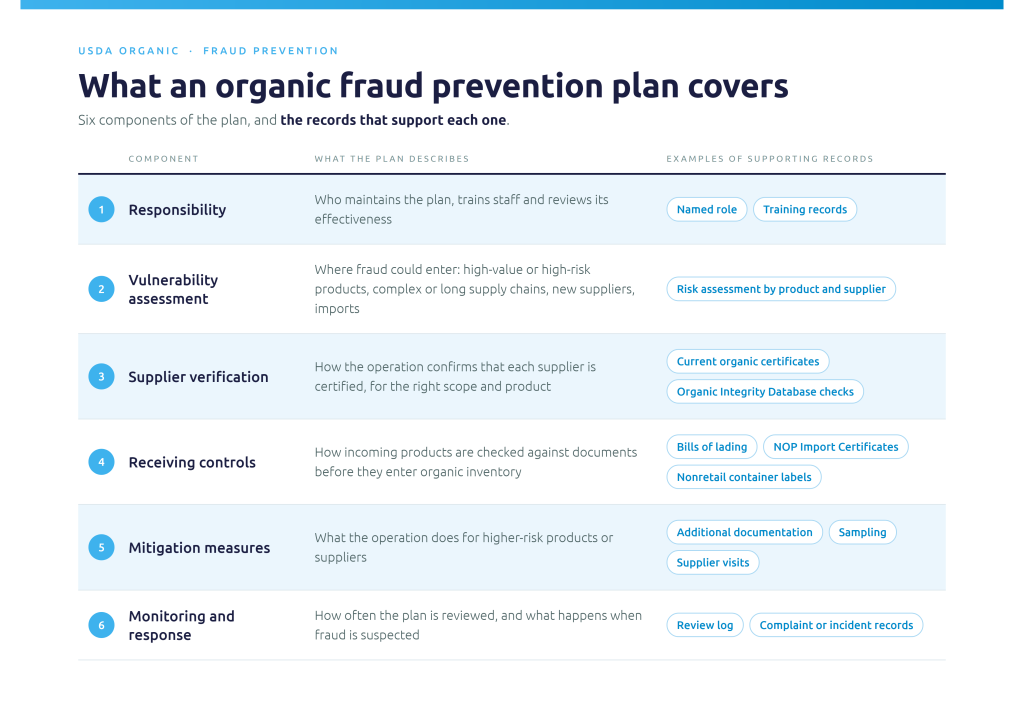
Records that support the plan must be kept for at least five years beyond their creation and made available to the certifier (7 CFR 205.103 and 205.400(d)). What inspectors review in those records during the annual visit is covered in [Insertar link: artículo “What Happens During a USDA Organic Inspection, and How Should You Prepare?” (/usda-organic-inspection-checklist/)].
Reviewing your Organic System Plan for SOE? Control Union Certifications reviews the Organic System Plan, including fraud prevention procedures, as part of USDA organic certification. [Insertar link: formulario de HubSpot de USDA Organic con UTM]
How does a certifier verify an organic fraud prevention plan?
A certifier verifies an organic fraud prevention plan by reviewing it as part of the Organic System Plan and then confirming on site that it is implemented. The question is not only whether the plan exists, but whether the operation’s records show that it works.
That verification happens at three levels:
- Document review. The certifier reviews the Organic System Plan, including the monitoring practices required under 7 CFR 205.201(a)(3), before certification and at each annual update.
- On-site inspection. The inspector verifies that the plan accurately reflects the practices in use, that quantities of organic product purchased and produced account for the product sold, and that products are traceable from the time of purchase (7 CFR 205.403(d)).
- Supply chain traceability audits. Accredited certifiers must maintain criteria to identify high-risk operations and products, conduct risk-based supply chain traceability audits, and exchange compliance-related information with other certifiers when needed to verify traceability (7 CFR 205.501 and 205.504).
A supply chain traceability audit follows a product across several certified operations, often certified by different certifiers. This is why the records of one operation can be reviewed as part of the verification of another.
How do supplier certificates fit into fraud prevention?
Supplier certificates are the first line of fraud prevention: an organic product can only be as reliable as the certification of the operation it comes from. Before accepting a product as organic, an operation should confirm that the supplier is currently certified and that its certified scope covers the product purchased.
The USDA Organic Integrity Database, maintained by the USDA Agricultural Marketing Service, is the public listing of certified organic operations and their certification status. SOE also standardized the certificates of organic operation issued by certifiers, and requires that nonretail containers used to ship or store organic products identify the product as organic.
For imported products, the NOP Import Certificate adds a shipment-level check: the importer verifies that each shipment matches the certificate issued by the exporter’s certifier.
How Control Union Certifications verifies organic supply chains
Control Union Certifications is a USDA-accredited certifying agent that inspects and certifies organic producers, handlers, importers and exporters under the USDA organic regulations, including the requirements of the Strengthening Organic Enforcement rule. Our inspectors verify the Organic System Plan on site, audit mass balance and traceability, and review the supplier verification records that support each organic claim.
With operations in more than 80 countries, Control Union verifies organic supply chains from origin to the U.S. market