
Who Needs USDA Organic Certification Under SOE?
Short answer: Since March 19, 2024, any operation that produces, handles, trades, imports, exports or facilitates the sale of organic products in the United States must hold USDA organic certification, unless it fits one of a small number of exemptions. The Strengthening Organic Enforcement (SOE) rule removed the exemption that allowed many importers, traders and brokers to operate uncertified.
U.S. organic sales reached $76.6 billion in 2025, up nearly 7%, according to the Organic Trade Association’s 2026 Organic Market Report. As supply chains grew longer and more international, uncertified links between certified operations became the main point where fraud could enter. SOE was designed to close those gaps.
What is the Strengthening Organic Enforcement rule?
SOE is the largest update to the USDA organic regulations (7 CFR Part 205) since the National Organic Program was created. USDA’s Agricultural Marketing Service published the final rule on January 19, 2023, and operations had until March 19, 2024 to comply.
The rule addresses six areas:
- Fewer uncertified entities in the supply chain
- Mandatory NOP Import Certificates for all organic imports
- Stronger recordkeeping, traceability and fraud prevention
- Clearer NOP authority over certification and enforcement
- Stronger oversight of certifiers, including unannounced inspections of at least 5% of certified operations
- Specific requirements for producer groups
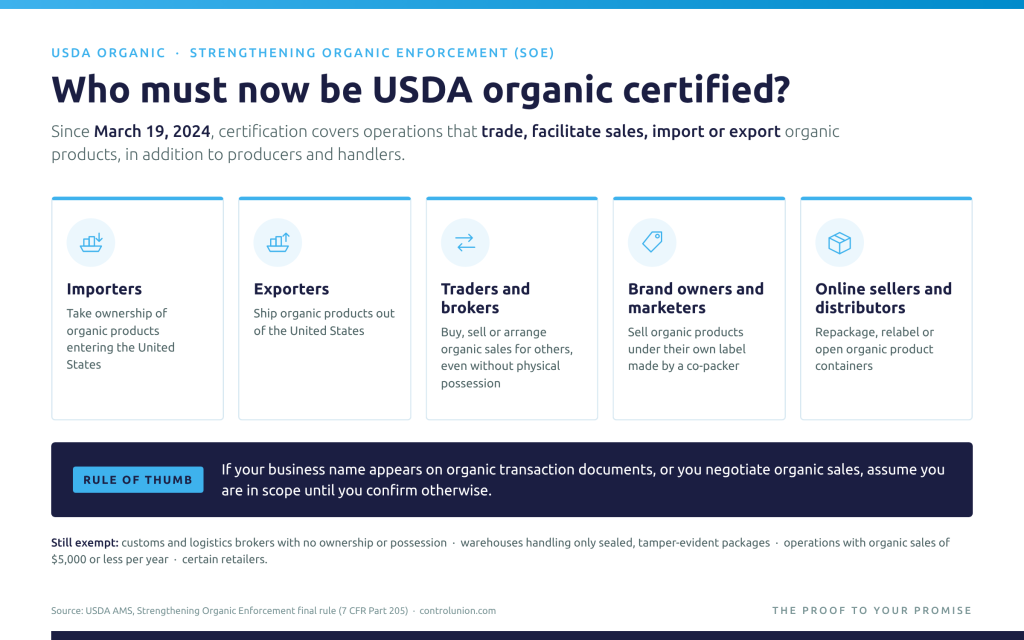
Role ambiguity is the most common source of confusion for trade businesses. Certification follows the activity, not the job title:
| If your company… | Certification required? |
| Takes ownership of organic product and brings it into the U.S. | Yes, as an importer |
| Buys and resells organic product without ever touching it | Yes, as a trader |
| Negotiates or arranges organic sales for others | Yes, as a broker, unless it is only a customs or logistics broker with no ownership or possession |
| Only clears shipments through customs or arranges freight | No, as a customs or logistics broker |
| Stores only sealed, tamper-evident retail packages | No, but must prevent contamination and keep records |
| Opens, repacks or relabels organic product | Yes, as a handler |
Which operations remain exempt?
SOE keeps a limited set of exemptions:
| Exempt operation | Condition |
| Very small operations | Gross organic sales of $5,000 or less per year |
| Certain retail establishments | Do not process organic products, or process only at the final point of sale to consumers |
| Storage and warehouse facilities | Handle only products in sealed, tamper-evident packages or containers |
| Distributors of retail-packaged goods | Handle only final retail-packaged products that remain unopened |
| Customs brokers and logistics brokers | Take neither ownership nor physical possession of organic products |
Transporters that move product between certified operations, or transload between modes, also do not need individual certification.
Exempt does not mean unregulated. Exempt operations must still prevent commingling and contamination, follow labeling rules and keep records that support the organic claim.
What else changed for certified operations?
Certification itself became more demanding. Under SOE, every certified operation must:
- Include a fraud prevention plan in its Organic System Plan (OSP), describing how it verifies suppliers and the organic status of the products it buys.
- Maintain full traceability records from purchase to sale, linked to the last certified operation in the chain.
- Label nonretail containers with organic identification and information that connects them to audit trail documents, such as lot numbers.
- Be ready for unannounced inspections. Certifiers must inspect at least 5% of their clients without notice each year.
- Pass mass-balance and trace-back audits during the annual on-site inspection.
Certificates are now issued in a standard format through the USDA Organic Integrity Database (OID), so buyers can verify a supplier’s status, scope and certified products in real time.
What happens if an operation in scope is not certified?
Selling, labeling or representing a product as organic without required certification is a violation of the Organic Foods Production Act and can lead to civil penalties. Commercially, the risk is more immediate: certified buyers must verify the certified status of their suppliers, and an uncertified link breaks the chain. Products can lose their organic status, and shipments can be held.
At the border, the consequences are immediate. Since October 1, 2025, organic shipments that arrive without a valid NOP Import Certificate can no longer be reconditioned (relabeled and sold as conventional). Uncertified importers may only re-export or destroy them. Certified importers may also donate them, with documentation.
How to confirm your scope and start
- Map your role in each organic transaction. Do you take ownership? Physical possession? Open, repack or relabel? Arrange sales?
- Check the exemptions table above against each activity, not only your main business.
- Search your suppliers and customers in the Organic Integrity Database to confirm their status.
- Contact an accredited certifying agent to confirm the applicable scope (crops, livestock, wild crops, handling) and the documentation required.
Control Union Certifications is accredited by the USDA to certify operations under the National Organic Program. Our auditors inspect producers, handlers, importers, exporters and traders, and we can combine your organic inspection with other programs such as PrimusGFS.
Do you need USDA organic certification?
Take the two-minute readiness check on our USDA NOP certification page. It sorts your operation by role (producer, processor, trader or brand owner, importer, handler) and routes your question to our certification team.