
USDA Organic Seal: What It Verifies and Who Can Use It
What Does the USDA Organic Seal Verify?
The USDA organic seal indicates that a product was produced and handled under the USDA organic regulations (7 CFR Part 205) by an operation certified by a USDA-accredited certifying agent. Only products labeled “100 percent organic” or “organic,” meaning at least 95% organic ingredients excluding water and salt, may display it.
Recognition of the seal is no longer the open question. According to the Organic Trade Association’s 2026 consumer perception study, conducted with Mercury Analytics in August 2026 among more than 1,000 Gen Z and Millennial shoppers, 90% are familiar with the USDA organic seal. The same study recommends that the organic sector now explain what the seal verifies.
Why does the USDA organic seal matter to buyers in 2026?
The USDA organic seal is the most recognized proof point in a growing category. Organic Trade Association data show that U.S. sales of certified organic products reached $76.6 billion in 2025, and the association’s 2026 consumer study found that 9 in 10 younger primary grocery shoppers recognize the seal.
The study, Communicating the Value of Organic: 2026 Messaging Insights for Reaching Millennial and Gen Z Consumers, surveyed shoppers who are responsible for their household’s groceries and had purchased organic in the previous six months. Among its findings:
- 78% associate organic with “no synthetic fertilizers, pesticides, or growth hormones.”
- 76% associate organic with “no artificial flavors, colors, additives, or preservatives.”
- 43% are willing to pay up to 20% more for an organic product, and 14% up to 30% more.
Shoppers who pay that difference rely on one assumption: that the seal on the package reflects a verified production and handling system. That assumption is what certification is designed to support.
What does the USDA organic seal actually verify?
The USDA organic seal verifies that the product comes from a certified operation that follows the USDA organic regulations from production through handling. It certifies a production system, documented and inspected, rather than a single test result on a finished product.
Behind the seal, the USDA organic regulations require that:
- The operation is certified. Operations that produce or handle products sold as organic must be certified by a USDA-accredited certifying agent (7 CFR 205.100), with limited exemptions.
- There is an approved Organic System Plan. The Organic System Plan (OSP) describes the practices, inputs, monitoring and recordkeeping the operation uses to comply (7 CFR 205.201).
- Prohibited substances and methods are excluded. Synthetic substances are prohibited unless they appear on the National List of Allowed and Prohibited Substances; genetic engineering and other excluded methods, ionizing radiation and sewage sludge are prohibited (7 CFR 205.105).
- Records support every organic claim. Certified operations keep records that show the organic status of what they produce, handle and sell (7 CFR 205.103).
- An inspector verifies the system on site. Certifiers conduct an on-site inspection of each certified operation at least once a year (7 CFR 205.403).
Certifiers also collect samples for residue testing from at least 5% of the operations they certify each year (7 CFR 205.670). What a USDA organic inspection covers in practice is explained in [Insertar link: artículo “What Happens During a USDA Organic Inspection, and How Should You Prepare?”
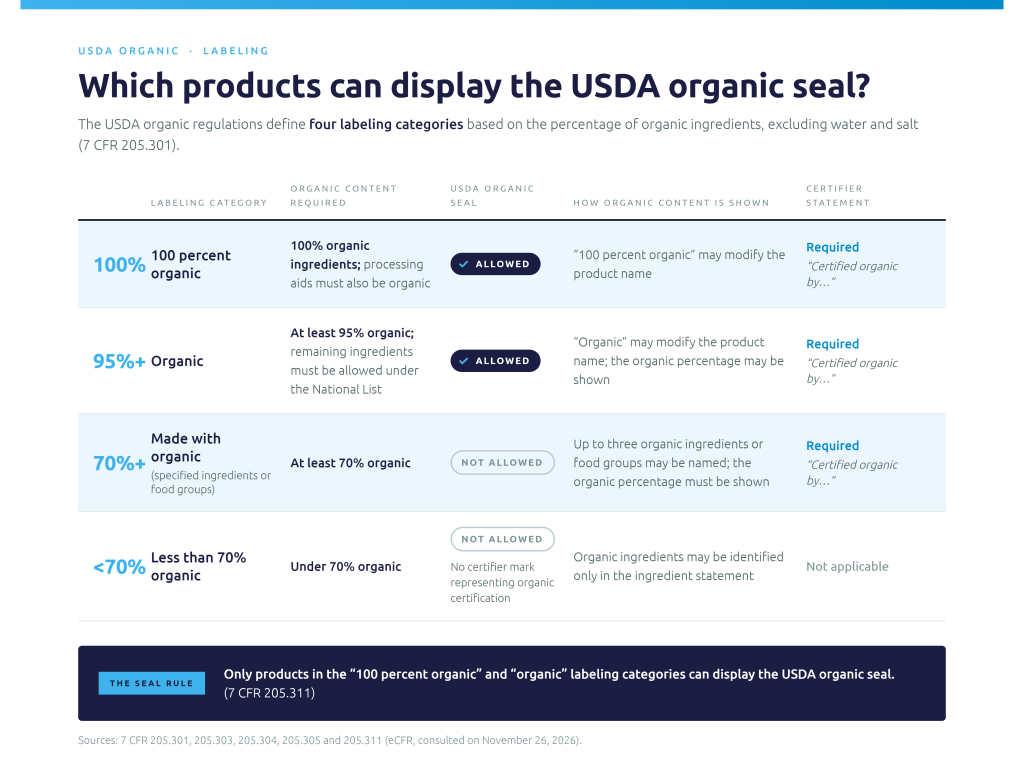
The seal is available in two approved versions: brown and green, or black and white. Either may appear with or without the registered trademark symbol, according to the USDA Agricultural Marketing Service.
Before your next label goes to print: Control Union Certifications reviews organic labels as part of the certification process.
Who reviews organic labels before they reach the shelf?
The accredited certifying agent reviews organic labels. Under USDA National Organic Program guidance, certifiers review product labels in the “100 percent organic,” “organic” and “made with organic” categories, as well as livestock feed, to verify compliance (NOP 5032).
For packaged products in the first three categories, the information panel must identify the certifying agent below the name of the handler or distributor, preceded by “Certified organic by” or a similar phrase (7 CFR 205.303 and 205.304). This statement links every certified package to the organization responsible for verifying the operation behind it.
How do shopper beliefs compare with what the regulations require?
Shopper beliefs about the USDA organic seal align closely with the regulations on inputs, and less closely on soil, climate and animal welfare. In the Organic Trade Association’s 2026 study, the attributes most associated with organic were the absence of synthetic inputs and artificial ingredients; the least associated were supporting farmers (40%), positive climate impact (39%) and animal welfare (35%).
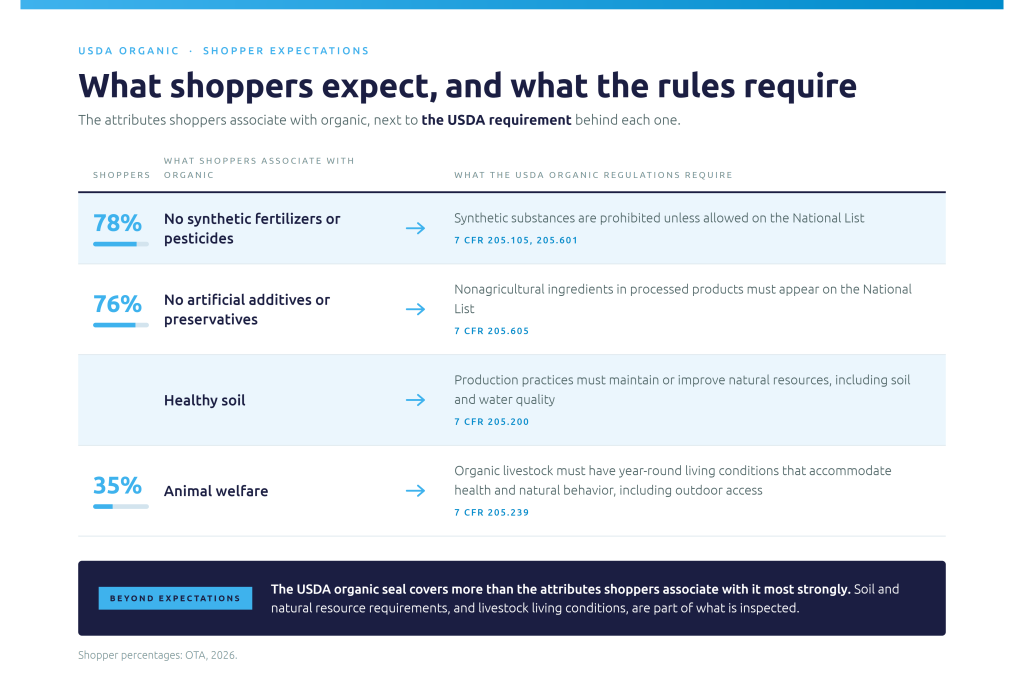
The USDA organic seal therefore covers more than the attributes shoppers associate with it most strongly. Soil and natural resource requirements, and livestock living conditions, are part of what is inspected.
What happens when the USDA organic seal is misused?
Selling or labeling a product as organic outside the USDA organic regulations is a federal violation. Under 7 CFR 205.662 and 7 CFR 3.91, a person who knowingly sells or labels a product as organic in violation of the Organic Foods Production Act is subject to a civil penalty of up to $22,974 per violation, the maximum set in the 2025 inflation adjustment.
The USDA National Organic Program publishes its enforcement settlement agreements. Since March 19, 2024, the Strengthening Organic Enforcement (SOE) rule has also required electronic NOP Import Certificates for every certified organic shipment entering the United States, explained in NOP Import Certificates: How They Work Under SOE
How Control Union Certifications verifies organic claims
Control Union Certifications is a USDA-accredited certifying agent that inspects and certifies organic producers, handlers, importers and exporters under the USDA organic regulations. Our inspectors verify the Organic System Plan on site, audit the records that support each organic claim, and our certification team reviews product labels before they are used.
With more than 100 years of experience and operations in more than 80 countries, Control Union provides the independent verification that stands behind the seal on your product.