
How to Get USDA Organic Certified: Manufacturers and importers
How to Get USDA Organic Certified: Steps, Timeline and Cost Factors for Producers, Handlers and Retailers
Short answer: To become USDA organic certified, an operation selects a USDA-accredited certifying agent, submits an Organic System Plan (OSP), passes a document review and an on-site inspection, and receives a certification decision. Cropland must be free of prohibited substances for 36 months before harvest. Once certified, the operation is inspected at least once a year.
Certification is not a one-time event. It is a management system that an independent certifier verifies every year. Understanding each stage helps operations plan realistic timelines and avoid delays.
Who needs to be certified?
Any operation that produces or handles agricultural products sold, labeled or represented as organic, with limited exemptions. Since the Strengthening Organic Enforcement (SOE) rule took effect in March 2024, this includes most importers, exporters, traders and brokers. See our guide on who needs USDA organic certification under SOE.
Retailers, co-packers and private label: who certifies what?
When a retailer sells an organic product made by a co-packer, both operations usually need certification: the co-packer for processing, the brand owner for selling the product under its label. Each must hold its own Organic System Plan and certificate in the Organic Integrity Database.
Three points deserve attention in the Organic System Plan for handlers:
- Label review. Organic claims, the USDA seal and the certifier statement must be approved by the certifier before printing. Plan reviews into the product launch calendar.
- Ingredients and suppliers. Every organic ingredient needs a current certificate from its supplier. Formulation changes or new suppliers require an OSP update.
- Responsibilities in writing. The agreement between brand owner and co-packer should state who manages supplier certificates, label approval and records for each product.
The certification process, step by step
- Confirm eligibility. For crops, verify that no prohibited substances were applied to the land in the 36 months before the first organic harvest. For handlers, confirm that suppliers are certified.
- Select a USDA-accredited certifying agent. Confirm that it is accredited for your scopes and has auditors in your region.
- Prepare and submit the Organic System Plan. The OSP describes practices, inputs, monitoring, recordkeeping, contamination prevention and, since SOE, a fraud prevention plan.
- Document review. The certifier reviews the application and OSP and requests clarification where needed.
- On-site inspection. An inspector verifies that practices match the OSP, reviews records, and performs mass-balance and traceability checks. Samples may be taken.
- Final review and decision. The certifier reviews the inspection report. Minor issues may be resolved with corrective actions before certification is granted.
- Certificate issued in the Organic Integrity Database. Your status, scopes and products become visible to buyers.
- Annual update and inspection. Each year you update the OSP, pay fees and receive an inspection. Unannounced inspections may also occur.
How long does certification take?
Timelines depend on the completeness of the OSP, the complexity of the operation and the season. Once land is eligible, many operations should plan for several months from application to certificate. The most common causes of delay are incomplete OSPs, missing input documentation and records that do not support mass balance.
For crop producers, the 36-month transition period is the longest step and must be planned well before the first organic harvest.
What does certification cost?
Costs vary by certifier, scope, size and complexity. Typical components include:
- Application or new-client fee
- Annual certification fee, often linked to organic sales or operation size
- Inspection fee, including inspector time and travel
- Additional fees for added scopes, sites, products or import certificates
Request a written quote that itemizes these components, so you can compare certifiers on equal terms.
Federal cost share: deadline December 31, 2026
The USDA Organic Certification Cost Share Program (OCCSP) reimburses up to 75% of eligible certification costs, up to $750 per scope, for program years 2025 and 2026. Eligible costs include application, inspection and certification fees. Applications for both years are due December 31, 2026, through your local Farm Service Agency office or participating state agencies, and funds are paid on a first-come, first-served basis.
Common mistakes in a first application
- Using an input (fertilizer, pest control product, cleaner) without confirming it is allowed
- No buffer zones or contamination controls next to conventional fields
- Records that cannot connect harvest or purchase volumes to sales
- Missing certificates for organic ingredients or suppliers
- An OSP that describes ideal practices instead of real practices
Certification with Control Union
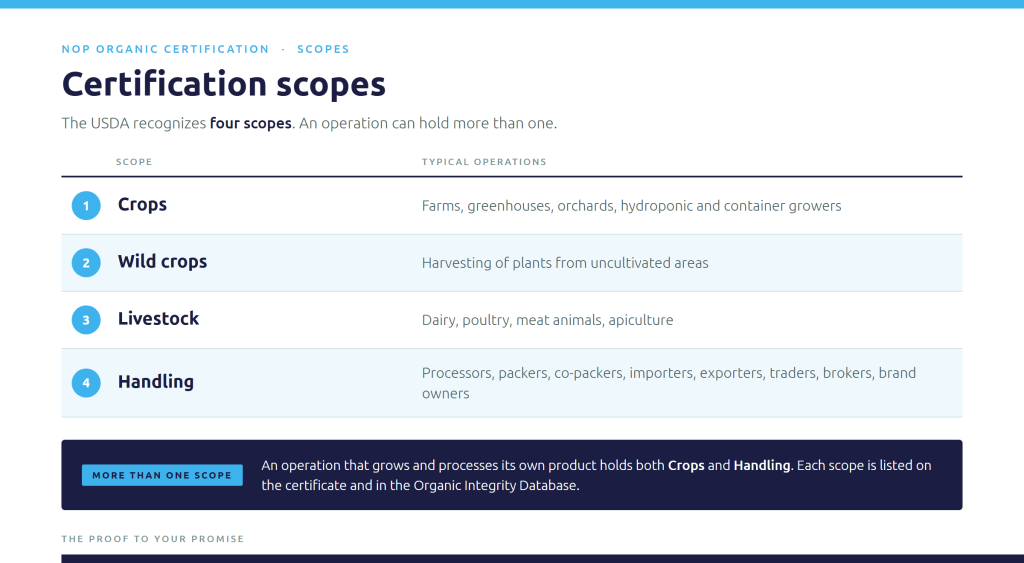
Control Union Certifications is accredited by the USDA to certify operations under the National Organic Program. We certify crop, wild crop, livestock and handling operations, and we can combine your organic inspection with PrimusGFS and other programs in a single visit.