
USDA Organic Inspection: What to Expect and How to Prepare
What Happens During a USDA Organic Inspection, and How Should You Prepare?
A USDA organic inspection is the on-site visit that a USDA-accredited certifying agent must conduct at least once a year at every certified operation. The inspector verifies that daily practices match the Organic System Plan (OSP), reviews fields, facilities and records, and completes a mass-balance audit and a trace-back audit to confirm organic integrity.
Since March 19, 2024, the implementation date of the Strengthening Organic Enforcement (SOE) rule, certifying agents must complete mass-balance audits during annual on-site inspections and verify traceability back to the previous certified operation in the supply chain (USDA Agricultural Marketing Service, Federal Register, January 19, 2023). Certifying agents must also inspect at least 5% of their certified operations without notice each year. For growers and handlers, inspection readiness is no longer tied to a scheduled date.
What does an inspector verify during a USDA organic inspection?
During a USDA organic inspection, the inspector confirms that the operation complies with the USDA organic regulations, that its Organic System Plan accurately describes its actual practices, and that prohibited substances are not being applied, as required by 7 CFR 205.403(c). The same section requires the inspector to verify mass balance and traceability.
The Organic System Plan (OSP) is the written description of how a certified operation produces or handles organic products. The annual inspection tests that document against what the inspector observes in the field, the facility and the records.
To make that verification possible, 7 CFR 205.400(c) requires the operation to grant complete access to the production or handling operation, including noncertified production and handling areas, structures and offices. Announced inspections also require a knowledgeable representative of the operation to be present.
What are mass-balance and trace-back audits?
A mass-balance audit verifies that an operation’s organic inputs account for its organic outputs. A trace-back audit verifies that an organic product can be followed from purchase through production and sale, back to the last certified operation in the supply chain. Both are required in every annual on-site inspection under 7 CFR 205.403(c).
In practice, a mass-balance audit compares quantities. For a crop producer, it relates acreage and harvest to quantities stored and sold. For a handler, it relates organic ingredients received to finished product produced, held in inventory and shipped.
A trace-back audit follows documents. The USDA organic regulations define an audit trail as documentation sufficient to determine the source, transfer of ownership and transportation of any organic product. Under SOE, certified operations must also use audit trails to verify that uncertified transporters do not compromise organic integrity.
Which records should be ready before the inspector arrives?
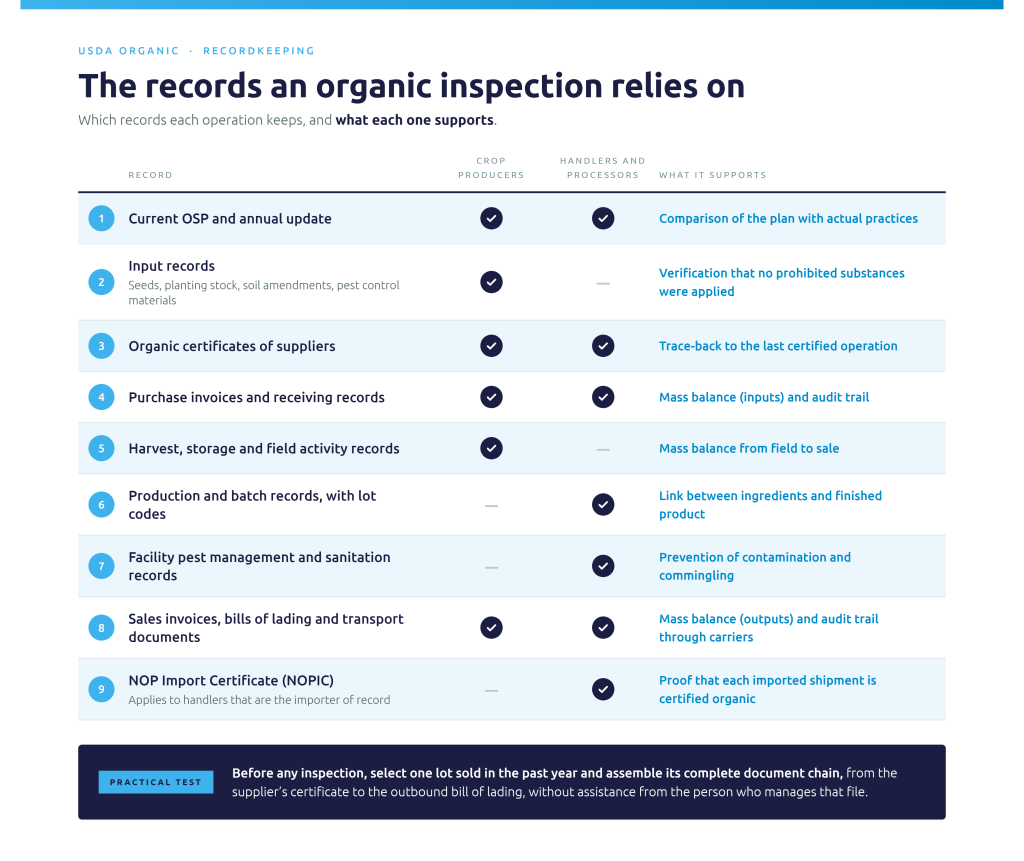
Organic records must be adapted to the business, disclose all activities and transactions in enough detail to be readily understood and audited, be kept for at least 5 years beyond their creation and demonstrate compliance with the regulations (7 CFR 205.103). They must be available for review during normal business hours.
The checklist below groups the records that support the verifications described above.
Can a USDA organic inspection be unannounced?
Yes. Under 7 CFR 205.403(b), each certifying agent must conduct unannounced inspections of at least 5% of the operations it certifies every year, rounded up to the next whole number. A certifying agent must be able to inspect any operation without notice and may not certify an operation where it cannot.
The National Organic Program instruction NOP 2609, Unannounced Inspections (Rev01, effective March 20, 2024), sets out how these visits work:
- Inspections take place without advance notice. In extenuating circumstances, such as biosecurity concerns, the certifying agent may notify the operation up to four hours before the inspector arrives.
- An unannounced inspection counts as the annual inspection only when the inspector can complete a full inspection of the operation.
- Refusing access to any part of the operation during normal business hours, including non-organic areas, is a violation of 7 CFR 205.403, and the certifying agent should promptly issue a notice of noncompliance.
When does the inspector collect samples for residue testing?
An inspector may collect samples during any inspection, announced or unannounced. Under 7 CFR 205.670, certifying agents must conduct periodic residue testing and sample at least 5% of the operations they certify each year; an agent that certifies fewer than 30 operations must sample at least one.
Samples may include soil, water, waste, seeds, plant tissue, and plant, animal and processed products. The inspector gives the operation a receipt for any sample taken, at no charge, and the certifying agent sends the operation the test results together with the inspection report (7 CFR 205.403(e)).
What happens after the inspection?
A USDA organic inspection closes with an exit interview. Under 7 CFR 205.403(d), the inspector meets with a knowledgeable representative of the operation to confirm the accuracy of the observations, identify any additional information needed and raise issues of concern.
After the visit, the certifying agent sends the operation a copy of the inspection report and any test results. The certifying agent then reviews the findings. Where the records or observations do not demonstrate compliance, the certifying agent can issue a notice of noncompliance that describes the issues to be resolved.
Certification continues from year to year. Under 7 CFR 205.406(a), a certified operation must pay its certification fees and submit an annual update with a summary of changes to its OSP, planned additions or deletions for the coming year and any changes to its business information.
USDA Organic inspection and certification with Control Union
Control Union Certifications is accredited by the USDA for the National Organic Program (NOP) and inspects and certifies organic operations that produce, process, handle, trade or import products for the U.S. market. Certification is renewed annually, and each inspection reviews records, inputs, processes, traceability and implementation.